About
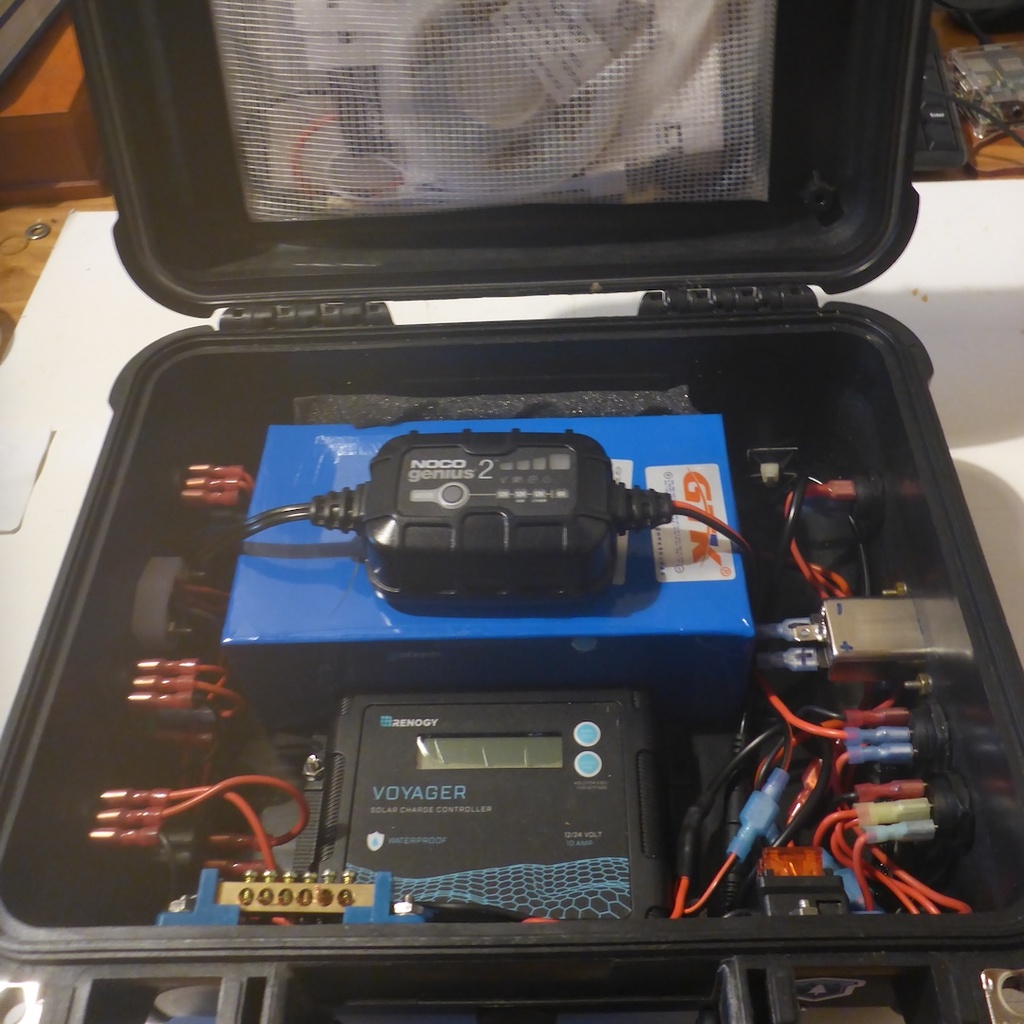
This is a series of two class sessions designed to help build an emergency back-up power supply. The power supply will be based on a 12-volt, deep-draw battery in a self-contained box, for those times when the power is out.
The first class session will start with a black plastic battery box. A trickle charger will be incorporated to maintain the battery to keep it topped off for those times when you really need it. A four gang fuse box will be installed to protect components. Additionally, switches will be added to control additional components as they are added. A battery isolation switch will be installed so that the entire power box can be turned off for safety. A cigarette lighter type receptacle (CLR) will be included to charge your battery operated devices – such as a lap top computer, tablet, or hand held radio.
Additional components will be added to the power box as time allows in the first session. These include a dual power pole panel mount receptacle with a 20 amp DC output to power a radio or other DC device. A 5 volt 4.2 Amp USB port will also be added for charging devices like cell phones and powering emergency LED lights. In addition, a switched panel mounted volt meter will be installed.
The second session will involve installation of any components not installed during the first session and the addition of a solar controller, and associated connectors. The Solar Controller allows the use of a solar panel to charge the battery. The second session will also be used to test the functionality of all the components in the emergency back-up power supply box.
There will be a number of instructors at the class to assist people in constructing their emergency power boxes. Those class participants with some building skills might be able to complete the class in one session.
Details:
- The materials cost for emergency back-up power supply box will be $150. A deep draw battery is not included in the cost. A handout will be provided and there will be discussion on what size and kind of deep draw battery can be added by the individual user.
- Please click here for BARN's current COVID-19 health & safety protocols.
- BARN is committed to accessibility. Tuition Assistance is available - click here to fill out the simple application before registering for a class. For those who might need physical assistance, please learn about BARN's Companion Program here.
Instructor Bios
Wade WA7DE and Jim K7EXP both hold the Extra certification, the highest HAM certification.
Jim, K7EXP, received a BA in Chemistry and Biology from PLU and an MS in Oceanography from OSU. He spent his civilian career exploring the world’s oceans while doing highly complex technical and scientific projects. He was an Air Force pilot in Vietnam where he had is first opportunity talking on radios. Jim has built various radio related projects for use when fly fishing and exploring remote locations in the Western US. He has been active in HAM radio for the last seven years and is a Trustee of the Bainbridge Island Amateur Radio Club.
Wade, WA7DE, has been a HAM since the early ‘70’s. He has built a plethora of various types of HAM radio equipment and likes experimenting with and building antennas. He served as a Trustee in the Bainbridge Island Amateur Radio Club. The Bainbridge Island Amateur Radio Club (BARC) supports HAM radio operators and those who want to become HAM radio operators at all levels.
Contact Doug Salot: ETA.Lead@BainbridgeBARN.org